You finally learned to read printed Russian. The street signs make sense, the menus are no longer a wall of shapes, and you can sound out кафе (kafe, "cafe") without sweating. Then a Russian friend writes you a quick note by hand, and it looks like a heart monitor flatlined into a row of identical loops. Welcome to Russian cursive, the version of the alphabet nobody warns you about.
Here is the good news. Russian cursive is not a second language. It is the same Cyrillic alphabet you already know, just dressed for the occasion. Once you see the handful of letters that cause real trouble, the rest fall into place fast. I have taught this to total beginners and to people who already speak decent Russian but freeze the moment someone writes by hand. The trick is the same for everyone: learn the lookalikes first, then practice with real words.
Why printed Russian and handwritten Russian look so different
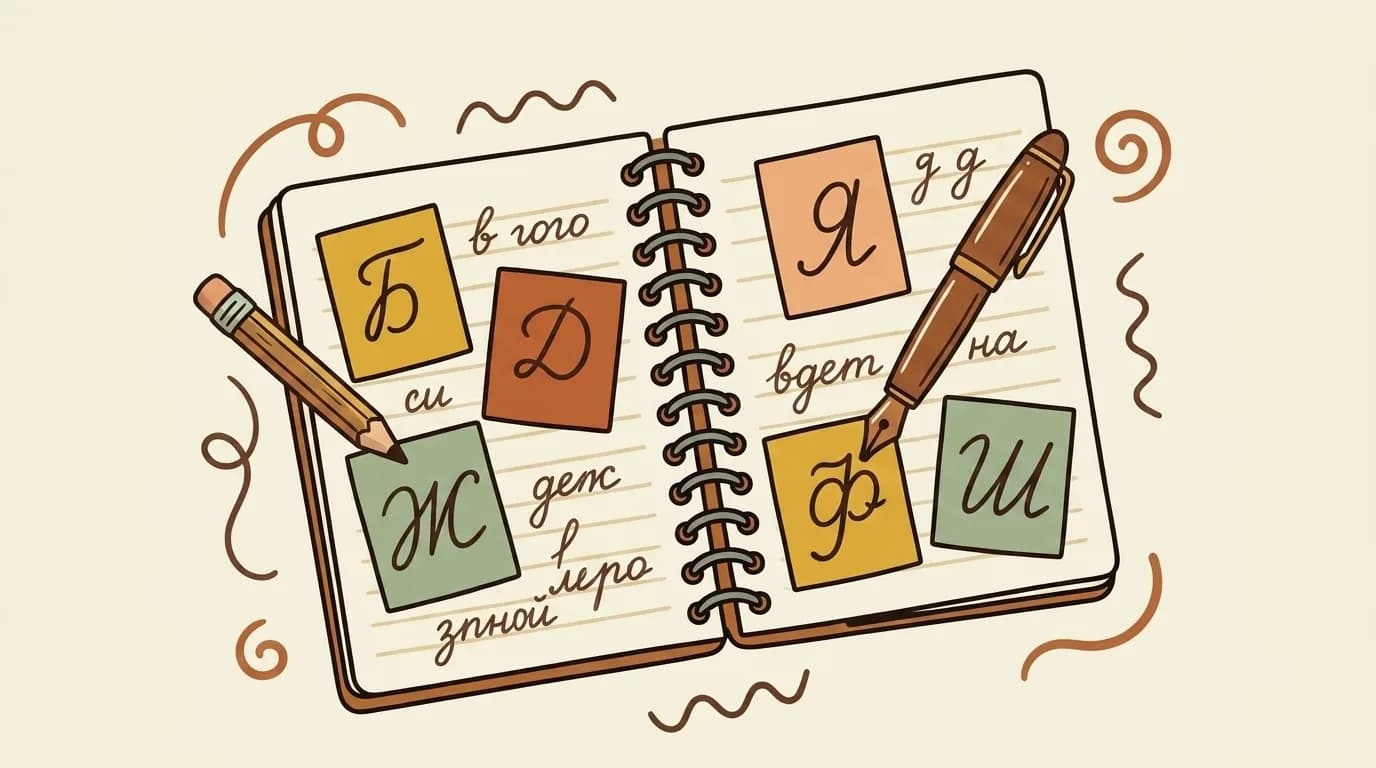
In English, cursive and print are close cousins. A handwritten "m" still has its humps. In Russian, several cursive letters abandon their printed shape entirely and become a smooth loop or a tooth. The result is that и, й, ш, м, л, and я can all blur into a chain of similar bumps if you do not know what to look for.
This is not Russians being difficult on purpose. Cursive exists because writing by hand is faster when your pen never lifts. Every loop and connector is there to keep the pen moving. The cost is that some letters lose their distinguishing features and start to resemble each other. Your job is to learn the small clues that keep them apart.
Tip: Do not try to memorize cursive as a fresh alphabet. Anchor every cursive letter to the printed letter you already know. You are learning costumes, not new characters.
The cursive letters that actually cause trouble
Most cursive letters are recognizable. These are the ones that ambush English speakers, so spend your energy here.
т in cursive often looks like an English "m," and м keeps a pointed, connected form whose shape varies with handwriting. That swap alone derails a lot of beginners. The word там (tam, "there") can read like "mam" until your brain adjusts.
и is a single bump like a "u." ш is three of those bumps in a row. щ is ш with a little tail. When they connect to their neighbors, the complete strokes, tails and word context help distinguish them.
л and м both start with a small hook. л is two strokes, м is three. я (the "ya" sound) in cursive also begins with a hook and can hide inside a chain of bumps.
в in cursive looks like a tall loop, close to an English "b." д (the "d" sound) often gets a loop that dips below the line, like a "g" or a "q." And г stays simple, a single downstroke, even though in print it looks like a backward "r."
Printed
Cursive trap
What it really is
т
Looks like English "m"
the "t" sound
м
Pointed connected form; distinguish its entry stroke
the "m" sound
и
One "u" bump
the "ee" sound
ш
Three "u" bumps
the "sh" sound
л
Hook plus a leg
the "l" sound
д
Loop dipping below the line
the "d" sound
Heads up: When a handwritten word looks like pure soup, count the bumps and find the hooks. Bumps separate и from ш. Hooks separate л, м, and я from the bumps around them.
The letters that barely change
Now the relief. Plenty of cursive letters keep their printed shape, so you already know them.
а, о, е, к, and с look almost the same handwritten as they do in print. р still drops a tail below the line like an English "p." у still looks like a "y" diving down. These are your anchor letters in handwriting, exactly the way they were when you first learned to read Cyrillic. When a word overwhelms you, find an anchor letter, lock onto it, and read outward from there.
If you have not nailed the printed alphabet yet, do that first. Cursive is far easier once the printed shapes and sounds are automatic, so it is worth getting the foundation solid before you wrestle with handwriting.
How to write Russian cursive yourself
Reading cursive and writing it are different muscles, and writing it is what makes reading it click. When your own hand has formed the loops, your eye recognizes them instantly in someone else's note.
Start with single letters, not words. Write a full line of и, then a full line of ш, then a line alternating the two so your hand feels the difference between one bump and three. Do the same for the т and м pair. Five minutes of this beats an hour of staring.
Then write short, familiar words by hand: мама (mama, "mom"), дом (dom, "house"), имя (imya, "name"), школа (shkola, "school"). Say each word out loud as you write it so the sound, the shape, and the meaning lock together.
Tip: Use lined paper and let the loops cross the lines the way they are supposed to. д, з, and у dip below the baseline. Keeping those tails consistent is what makes your handwriting readable to a Russian.
Practice with handwriting you will actually meet
Drills get you started, but real handwriting is the goal. Find a short handwritten note online, a recipe card, or a caption in someone's photo, and transcribe it into printed Russian. The context fills the gaps your eyes miss, and every word you decode trains the next one.
Another favorite of mine: ask a Russian-speaking friend to write you one sentence by hand, then read it back to them out loud. They will correct you instantly, and the embarrassment of misreading так as "mak" is the fastest teacher there is.
Why handwriting is worth the effort
You could skip cursive. Plenty of learners do, and they get by with print and keyboards. But you will hit a ceiling. Handwritten notes, signatures, whiteboards in a class, a card from someone who matters, all of it stays locked until you can read by hand. Learning cursive is the difference between reading the language and reading only the parts of it that were typed for you.
It also makes you feel fluent in a way printed text never does. The first time you read a handwritten Russian sentence at normal speed, without translating shape by shape, you will know the alphabet finally belongs to you.
If you want a shortcut, this is exactly the kind of thing we knock out fast in 1-on-1 lessons. I write a sentence, you read it back, we laugh at the bumps, and within a few sessions handwriting stops being scary. But you do not need a lesson to begin. You need a pen and ten minutes.
Try this today
Write the bump pairs. Fill one line each of и and ш, then alternate them. Do the same for т and м. Say the sounds as you go.
Copy four easy words by hand. Try мама (mama, "mom"), дом (dom, "house"), имя (imya, "name"), and кот (kot, "cat"). Read each one out loud.
Find one handwritten word online and transcribe it into printed letters. Use the context to check your guess.
Write your own name in Russian cursive. Seeing yourself on the page in handwriting makes the whole alphabet feel real.
Ask a Russian speaker to handwrite one short sentence, then read it back to them. Let them correct you. That single correction will teach you more than a page of drills.
You do not have to master Russian cursive this week. But you can stop fearing it today. It is the same alphabet you already know, just moving a little faster.
A five-minute transcription practice
Use a notebook for this exercise. The text below is printed Cyrillic, not a handwriting model: it gives you a reliable answer to compare with your own writing.
Copy Это мой дом. Тут живёт Миша. in the handwriting style you are learning. Keep spaces between words.
Circle each т, м, и and ш. Check the complete letter shape, including its entry and exit strokes; do not guess from one bump alone.
Cover the text. Play the recording and write the two sentences from dictation.
Uncover the original and check the words, capitals, punctuation and ё. Read your own version again tomorrow before looking at the answer.
Read, cover, then write
Это мой дом. Тут живёт Миша.
This is my house. Misha lives here.
Read the sentence before listening. Then cover it, write from the recording and compare letters, word spaces and the dots over ё.
AI-generated practice audio; not a recording of Alex.
Check your transcription and translate it
Это мой дом. Тут живёт Миша. means “This is my house. Misha lives here.” The repeated т occurs in Это, Тут and живёт; м appears in мой, дом and Миша. If a letter is unclear, rewrite the whole word with more space rather than adding arbitrary loops. A teacher's handwritten model is needed to check stroke direction; the audio checks the words, not pen technique.
For the next exercise, read the syllable practice aloud before copying the words.