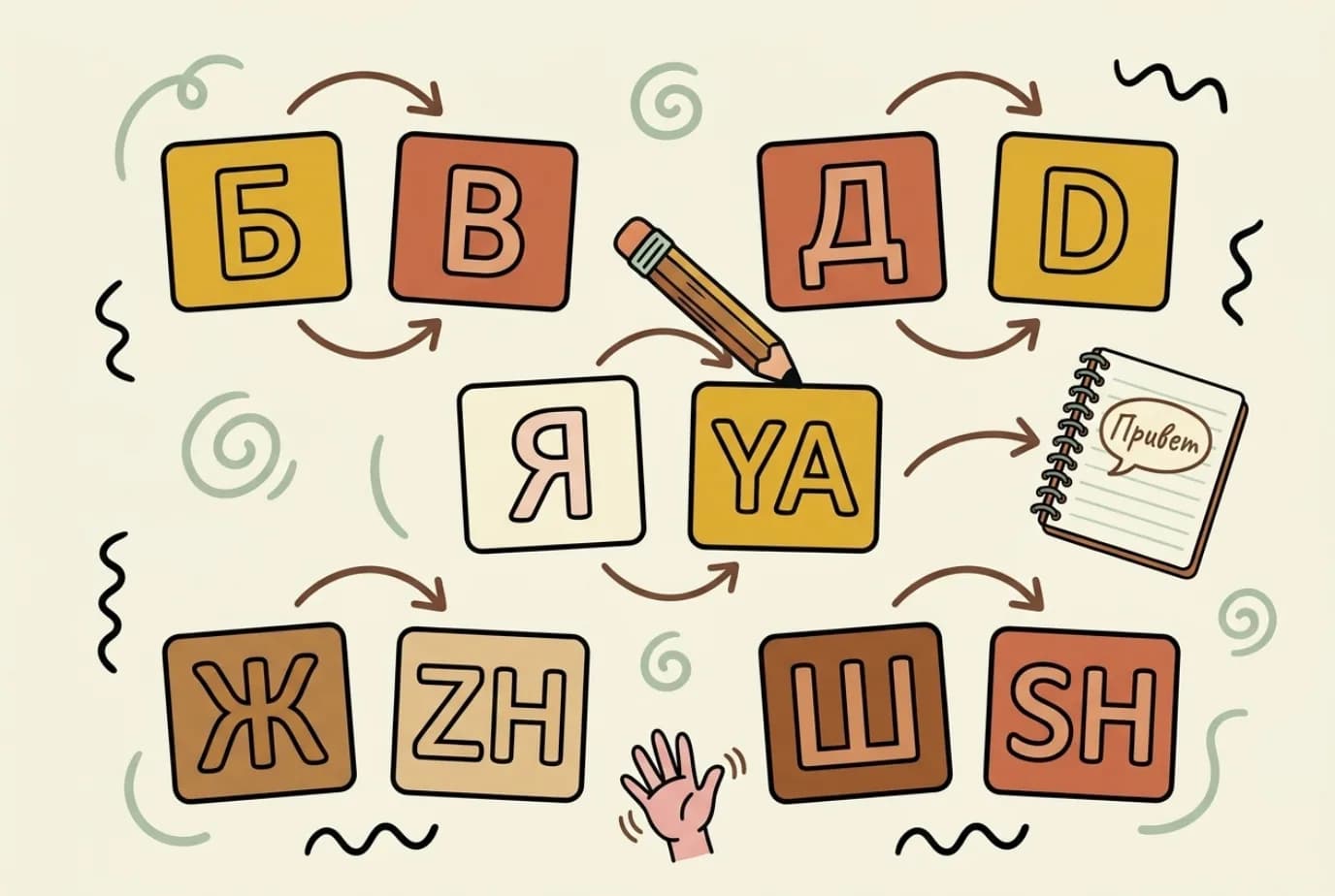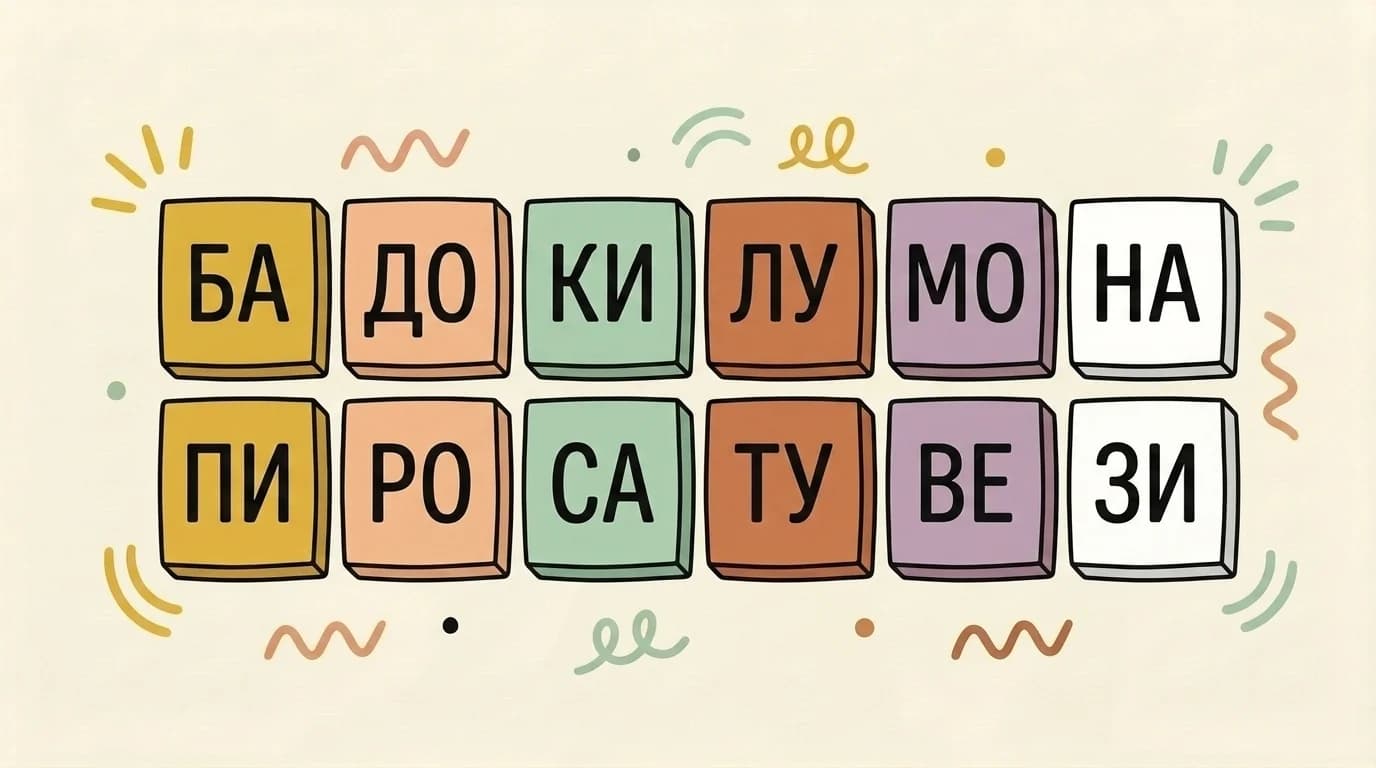
Knowing the 33 Cyrillic letters is only the first step in reading Russian. Real words add word stress, the contrast between hard and soft consonants, and sound changes in unstressed syllables or consonant clusters.
This guide takes those one at a time. It does not promise instant fluency or a magic list of “most common” syllables. The goal is to read a small set of real words accurately, understand why they sound the way they do, and reuse the method on unfamiliar words.
Keep the Cyrillic-to-English reference chart open if the letters are still new. You can also warm up with the free Russian alphabet quiz.
Four signals to watch
- Stress matters. Dictionaries mark the stressed syllable with an acute accent:
молоко́. Ordinary Russian text usually leaves it out. - Unstressed vowels can change. Unstressed
оoften moves toward a reduced uh or ah sound in standard pronunciation.Молоко́is therefore closer to muh-la-KO than mo-lo-KO. - Softness belongs to the consonant.
Е,ё,и,ю, andяoften signal that the preceding consonant is palatalized, or “soft.” This is not simply a separate English y after it. - Neighboring consonants affect one another. Voicing can change in a cluster, and some written consonants disappear in everyday pronunciation.
The reading guides below are approximations for English speakers, not formal transliterations or substitutes for audio.
Round 1: transparent words
| Russian | Reading guide | Meaning | Notice |
|---|---|---|---|
ма́ма | MA-ma | mom | stress first |
па́па | PA-pa | dad | two open syllables |
ко́т | kot | cat | one stressed vowel |
дом | dom | house | one syllable |
суп | soop | soup | у resembles oo in boot |
метро́ | me-TRO | metro | final stress |
такси́ | tak-SEE | taxi | recognizable loanword |
му́зыка | MOO-zy-ka | music | ы has no exact English equivalent |
Read the table twice. On the second pass, cover the middle column and make the stressed syllable clear.
Round 2: hard and soft consonants
A soft consonant is made with the middle of the tongue raised toward the hard palate while the consonant is pronounced. Spellings such as ny and ly are reminders only.
| Harder consonant | Softer consonant | Contrast |
|---|---|---|
мат (mat) | мять (myat') | м versus soft м |
нос (nos, nose) | нёс (nyos, carried) | н versus soft н |
лук (look, onion/bow) | люк (lyook, hatch) | л versus soft л |
был (byl, was) | бил (beel, beat) | hard + ы versus soft + и |
Do not add a full extra syllable. For люк, begin the л with your tongue already raised, then move into the vowel.
The soft sign ь can also mark a preceding consonant as soft: compare у́гол (OO-guhl, corner) with у́голь (OO-guhl', coal). It has no vowel sound of its own.
Round 3: stress and vowel reduction
Find the accent mark before reading.
| Russian | Reading guide | Meaning |
|---|---|---|
вода́ | va-DA | water |
окно́ | ak-NO | window |
молоко́ | muh-la-KO | milk |
хорошо́ | khuh-ra-SHO | well / good |
Москва́ | mask-VA | Moscow |
спаси́бо | spa-SEE-ba | thank you |
These guides reflect a common standard pronunciation. Reduction also depends on distance from the stress, surrounding consonants, speech rate, and accent. The useful beginner rule is: locate the stress first; do not give every written vowel equal weight.
Compare во́ды (VO-dy, waters), вода́ (va-DA, water), and во́дный (VOD-ny, water-related). The root stays recognizable, but its vowels do not sound identical in every form.
Round 4: consonant clusters
Work from a slow version toward a natural one without inserting English-style vowels between consonants.
| Russian | Reading guide | Meaning | Practice split |
|---|---|---|---|
страна́ | stra-NA | country | стра + на |
встре́ча | FSTRYE-cha | meeting | встре + ча |
зда́ние | ZDA-ni-ye | building | зда + ние |
сказа́ть | ska-ZAT' | to say | ска + зать |
пра́здник | PRAZ-neek | holiday | written д is normally silent |
здра́вствуйте | ZDRAS-tvooy-tye | hello | often reduced in everyday speech |
In встре́ча, written в is commonly devoiced before с, so the beginning approaches фстр-. This is an effect of neighboring sounds, not an extra spelling to memorize.
Здра́вствуйте has three syllables: здрав-ствуй-те. Speakers often simplify its consonant cluster, but the exact reduction varies. Start with a slow three-syllable version.
Five-line reading drill
Read each line slowly, then with clear stress, then at a comfortable pace.
Ма́ма до́ма.— Mom is at home.Вот моё окно́.— Here is my window.Мы идём в метро́.— We are going to the metro.Здра́вствуйте! Как дела́?— Hello! How are you?Хорошо́, спаси́бо.— Good, thank you.
On the final pass, connect each line as a phrase instead of pausing after every syllable.

Check yourself
- Add stress to
молокоand divide it into syllables. - Which letter tells you that
лis soft inлюк? - Why is the first letter of
встречаoften heard closer toф? - How many syllables are in
здравствуйте? - Mark the stress in
Спасибо. Мы идём в метро.
Answers
мо-ло-ко́: three syllables, with final stress; approximately muh-la-KO.юsignals that the precedingлis soft.- Written
вcomes before voicelessсand is commonly devoiced in the cluster. - Three:
здрав-ствуй-те. Спаси́бо. Мы идём в метро́.The stresses fall onси,дём, andтро.
A repeatable ten-minute routine
For five new words: look up the stress; divide each word into syllables; circle letters that signal softness; underline unstressed о and а; then listen to a reliable recording and repeat it. Keep a small list of words you can read accurately. Accuracy makes later speed possible.
If you want feedback on sounds you cannot hear or reproduce yet, Alex offers private 60-minute lessons on Google Meet for $35 and a 10-lesson pack for $300. Start with a free 30-minute trial, with no card or commitment.
Sources used for the pronunciation notes
- Cornell University: Russian letters and sounds
- Cornell University: palatalized and unpalatalized consonants
- Journal of the International Phonetic Association: Russian
From isolated syllables to a listening check
An isolated syllable does not teach the stress or vowel reduction of a whole word. Try this short transfer test after the four rounds above.
Мама. Мимо. Мыло. Шина. Машина. Тихо.
Mum. Past or by. Soap. Tyre. Car. Quietly.
Stress: ма́ма, ми́мо, мы́ло, ши́на, маши́на, ти́хо. Listen for hard м in мы and soft м in ми; ш stays hard even in ши.
AI-generated practice audio; not a recording of Alex.
- Read
ма́ма — ми́мо — мы́лоaloud. Keep the firstмhard inмаandмы, and soft inми. - Compare
ши́наandмаши́на. The spellingшиcontainsи, butшstays hard. Move the stress to the second syllable inмашина. - Cover the transcript and listen. Write the six words, then add the stress marks from memory.
- Check below. Repeat only the words you missed before trying the whole sequence again.
Answer key and what to practise next
ма́ма, ми́мо, мы́ло, ши́на, маши́на, ти́хо. If you mixed up ми and мы, return to that contrast rather than repeating every row. If you stressed ма́шина, practise ши́на → маши́на. If spelling was right but a word sounded different, listen at normal speed after the slow replay; syllable drills are a bridge to natural speech.