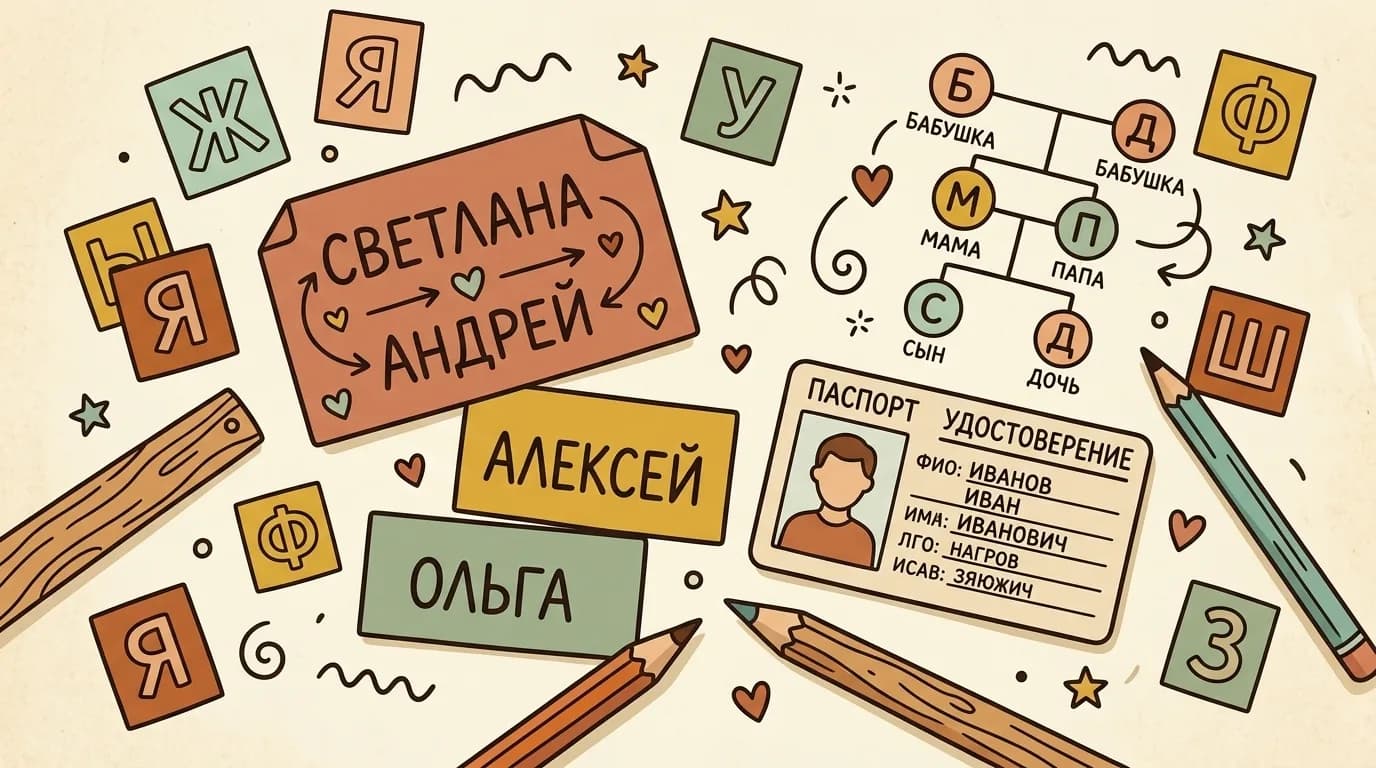
A traditional full Russian name has three parts: first name, patronymic, and surname, as in Лев Николаевич Толстой (Lev Nikolaevich Tolstoy). The patronymic comes from the father's first name, while many surnames change ending for men and women: Ivanov becomes Ivanova. The first time my American students notice those patterns, they assume someone made a typo. They did not. Let me walk you through the whole system, calmly, the way I do with my students.
Looking for your own spelling first? The free name in Russian converter writes an English name in Cyrillic, with reviewed common spellings and a clearly labelled phonetic fallback.
The three-part Russian name
A traditional full Russian name is often introduced as first name, patronymic, and surname (last name). The order can change in lists and documents. Take the most famous example, the writer:
Лев Николаевич Толстой (Lev Nikolaevich Tolstoy)
Here Лев (Lev) is the first name, Николаевич (Nikolaevich) is the patronymic, and Толстой (Tolstoy) is the surname. The middle piece, the patronymic, is the one English speakers do not have, so it feels the strangest. It is not a middle name in the American sense. It is built directly from the person's father's first name, and it tells you, quite literally, whose child this is.
On official forms you often see the abbreviation ФИО (FIO), short for Фамилия, Имя, Отчество (Familiya, Imya, Otchestvo), meaning surname, first name, patronymic. So on paper the order flips to put the surname first. Spoken, though, the natural order is the one above.
Fill in the right name field
Here is a fictional example you can use to practise reading a form:
| Field on a Russian form | Meaning | Example |
|---|---|---|
Фамилия | Surname / family name | Иванова |
Имя | First / given name | Анна |
Отчество | Patronymic | Сергеевна |
Анна Сергеевна Иванова is the same person as Иванова Анна Сергеевна in a surname-first list. Read the field labels rather than assuming that the first box asks for a given name.
For an actual form, copy your name from the required identity document. Do not invent a patronymic if you do not have one; follow that form’s instructions for an absent patronymic. A transliteration tool is a learning aid, not an authority for passport spelling.
Анна Сергеевна Иванова. Здравствуйте, Анна Сергеевна.
Anna Sergeevna Ivanova. Hello, Anna Sergeevna.
The surname identifies her family. First name plus patronymic is a common respectful way to address her.
AI-generated practice audio; not a recording of Alex.
Check your understanding
A fictional list says Иванова Анна Сергеевна. Which part is the surname? What is a common respectful way to greet her? Does the patronymic mean her father’s surname is Сергеев?
Check the three answers
The surname is Иванова. A respectful greeting is Здравствуйте, Анна Сергеевна. Сергеевна is formed from the given name Сергей; it does not tell you the father’s surname.
How patronymics work
The patronymic is the father's first name plus a gendered ending. For a son, you add -ович (-ovich) or -евич (-evich). For a daughter, you add -овна (-ovna) or -евна (-evna). That is the core of it.
So if a father is named Иван (Ivan), his son's patronymic is Иванович (Ivanovich, son of Ivan) and his daughter's is Ивановна (Ivanovna, daughter of Ivan). If the father is Сергей (Sergei), the endings soften to Сергеевич (Sergeevich) and Сергеевна (Sergeevna).
| Father's name | Son's patronymic | Daughter's patronymic |
|---|---|---|
Иван (Ivan) | Иванович (Ivanovich) | Ивановна (Ivanovna) |
Пётр (Pyotr) | Петрович (Petrovich) | Петровна (Petrovna) |
Сергей (Sergei) | Сергеевич (Sergeevich) | Сергеевна (Sergeevna) |
Александр (Aleksandr) | Александрович (Aleksandrovich) | Александровна (Aleksandrovna) |
Tip: You do not need to generate patronymics on the fly. Just recognize them. If a middle name ends in
-ович/-евичor-овна/-евна, you are looking at a patronymic, and you can quietly deduce the person's father was named whatever comes before that ending.
Why Russian last names are gendered
Now to the question that started this whole article. Many common Russian surnames have masculine and feminine forms. The pattern depends on the surname ending; it is not a rule for every Russian surname. If you are still fuzzy on why Russian words carry gender at all, my short Russian gender for English speakers explainer will make this click in five minutes.
Many familiar surnames use the following ending families, and each has a male and a female form:
| Male ending | Female ending | Example (male / female) |
|---|---|---|
-ов (-ov) | -ова (-ova) | Иванов (Ivanov) / Иванова (Ivanova) |
-ин (-in) | -ина (-ina) | Пушкин (Pushkin) / Пушкина (Pushkina) |
-ский (-skiy) | -ская (-skaya) | Достоевский (Dostoevsky) / Достоевская (Dostoevskaya) |
-ев (-ev) | -ева (-eva) | Медведев (Medvedev) / Медведева (Medvedeva) |
So Mr. and Mrs. Ivanov are Иванов and Иванова. The famous tennis player is Мария Шарапова (Maria Sharapova), and her father is Шарапов (Sharapov). Same family, two endings. A small group of surnames does not change, usually ones that end in -о, -ко, or -их, like Шевченко (Shevchenko) or Толстых (Tolstykh). Those stay identical for men and women, which is a small mercy.
What common Russian surnames mean
Here is the part students love. Most Russian last names started as a way of saying "son of someone" or "the one who does this job," so they carry real meanings. The -ов/-ев and -ин endings mostly mean "belonging to" or "son of."
| Surname | Meaning |
|---|---|
Иванов (Ivanov) | son of Ivan (Russia's John) |
Кузнецов (Kuznetsov) | son of the smith (кузнец, kuznets, blacksmith) |
Смирнов (Smirnov) | from смирный (smirnyy, quiet, meek) |
Попов (Popov) | son of the priest (поп, pop) |
Волков (Volkov) | from волк (volk, wolf) |
Соколов (Sokolov) | from сокол (sokol, falcon) |
Медведев (Medvedev) | from медведь (medved', bear) |
Морозов (Morozov) | from мороз (moroz, frost) |
Новиков (Novikov) | from новый (novyy, new, the newcomer) |
Кузнецов (Kuznetsov) is the Russian Smith, and it is one of the most common surnames in the country for the same reason: every village needed a blacksmith. Once you see the roots, surnames stop being random sounds and turn into tiny dictionaries.
First names and their diminutives
Russian first names look intimidating in full, but in daily life almost nobody uses the full version with friends and family. Each name has a standard short form, a diminutive, and these can sound nothing like the original. This confuses learners the most, so let me lay it out.
| Full name | Common diminutive(s) |
|---|---|
Александр (Aleksandr) | Саша (Sasha), Шура (Shura) |
Дмитрий (Dmitri) | Дима (Dima), Митя (Mitya) |
Екатерина (Ekaterina) | Катя (Katya) |
Александра (Aleksandra) | Саша (Sasha) |
Михаил (Mikhail) | Миша (Misha) |
Анна (Anna) | Аня (Anya) |
Николай (Nikolai) | Коля (Kolya) |
Мария (Maria) | Маша (Masha) |
Владимир (Vladimir) | Вова (Vova), Володя (Volodya) |
Татьяна (Tatyana) | Таня (Tanya) |
Notice that Александр (Aleksandr, the man) and Александра (Aleksandra, the woman) both shorten to Саша (Sasha), which is genderless. That is normal. You just memorize these pairs the way you memorized that "Bob" comes from "Robert."
Hear the short forms
Александр. Саша. Александра. Саша. Дмитрий. Дима. Мария. Маша.
Aleksandr: Sasha. Aleksandra: Sasha. Dmitri: Dima. Maria: Masha.
Саша can refer to Александр or Александра. Use the form the person introduces themselves with.
AI-generated practice audio; not a recording of Alex.
Start with the form a person uses to introduce themselves. A familiar nickname can be welcome among friends but need not suit a first meeting. If you are unsure, ask: Как к вам обращаться? (“How should I address you?”).
For the letters in these names, use the Cyrillic transliteration table. Practise the rest of a polite exchange with thank you and you’re welcome.
How Russians actually address each other
Here is the practical payoff. In formal or respectful settings, Russians do not say "Mr. Smith." They use the first name plus the patronymic. Your teacher, your doctor, your boss, an older neighbor: you address them as, for example, Иван Петрович (Ivan Petrovich) or Анна Сергеевна (Anna Sergeevna). No surname needed, and it is warm but respectful at the same time.
With friends, family, and children, you drop the patronymic entirely and use the diminutive: Саша (Sasha), Катя (Katya), Дима (Dima). Getting this register right matters more than perfect grammar, honestly. Call your professor by her bare first name and it lands as rude. Call your friend by his full name and patronymic and he will laugh and ask what he did wrong. If you want the polite openers that go with this, I keep them in my essential Russian phrases guide.
A few famous names to anchor it: Фёдор Михайлович Достоевский (Fyodor Mikhailovich Dostoevsky) and Юрий Алексеевич Гагарин (Yuri Alekseevich Gagarin), the first human in space. Read them slowly and you can now decode each one: first name, father's name baked into the patronymic, then the family surname with its gendered ending.
This is the kind of thing that is faster to absorb out loud with someone correcting your stress and endings in real time. If you want a patient native speaker to drill the patronymic system and name registers with you directly, that is what I do in my 1-on-1 Russian lessons, and you are welcome to book a session.
Try this today
- Practise with the fictional first name
Иван: identifyИвановичandИвановнаin the table. Do not add an invented patronymic to a real identity document. - Take the surname
Иванов(Ivanov) and make the female form, then do the same forПушкин(Pushkin) andДостоевский(Dostoevsky). - Learn three diminutives by heart:
АлександрtoСаша(Aleksandr to Sasha),ДмитрийtoДима(Dmitri to Dima),МарияtoМаша(Maria to Masha). - Look up one common surname from the meanings table and say its root word out loud, like
Кузнецов(Kuznetsov) fromкузнец(kuznets, smith). - Practice addressing an imaginary teacher formally: pick a first name and patronymic, like
Анна Сергеевна(Anna Sergeevna), and say a polite hello.
Quick answers about Russian names
What order does a full Russian name use?
In normal speech, the order is first name, patronymic, surname: Лев Николаевич Толстой. Official lists and forms often put the surname first: Толстой Лев Николаевич.
Is a Russian patronymic a middle name?
It occupies the middle position, but it is not a freely chosen middle name. A patronymic is formed from the father's first name and uses a masculine or feminine ending.
How do Russian patronymic names work?
A son of Ivan is usually Иванович (Ivanovich), while a daughter of Ivan is Ивановна (Ivanovna). Common endings are -ович/-евич for men and -овна/-евна for women.
Why are Russian last names gendered?
Many Russian surnames behave like adjectives, so their endings agree with gender. A man may be Иванов (Ivanov), while a woman in the same family is Иванова (Ivanova). Some surnames, including many ending in -ко or -их, do not change.
What is an example of a complete Russian name?
Фёдор Михайлович Достоевский is a complete name: Fyodor is the first name, Mikhailovich is the patronymic derived from Mikhail, and Dostoevsky is the surname.
What was Lev Tolstoy's patronymic?
Lev Tolstoy's full Russian name was Лев Николаевич Толстой. His patronymic, Николаевич (Nikolaevich), was formed from his father's first name, Nikolai.