Let me guess how you think you say cheers in Russian. You raise your glass, look someone in the eye, and confidently announce На здоровье (na zdorovye, "to health"). I have heard it at countless dinner tables, and every time my Russian heart winces a little. Here is the truth, and we are getting it out of the way in the very first paragraph: that is not how Russians say cheers. I will explain what we actually say, why the myth refuses to die, and how to toast like someone who has been invited back. By the end you will have real toasts, proper birthday wishes, and the etiquette that keeps you from accidentally insulting the host.
Toasting is not a side activity in Russian culture. It is the main event. A good toast can be a sentence or a three-minute story, and people genuinely listen. So let us build your toolkit from scratch.
Cheers in Russian: What We Actually Say
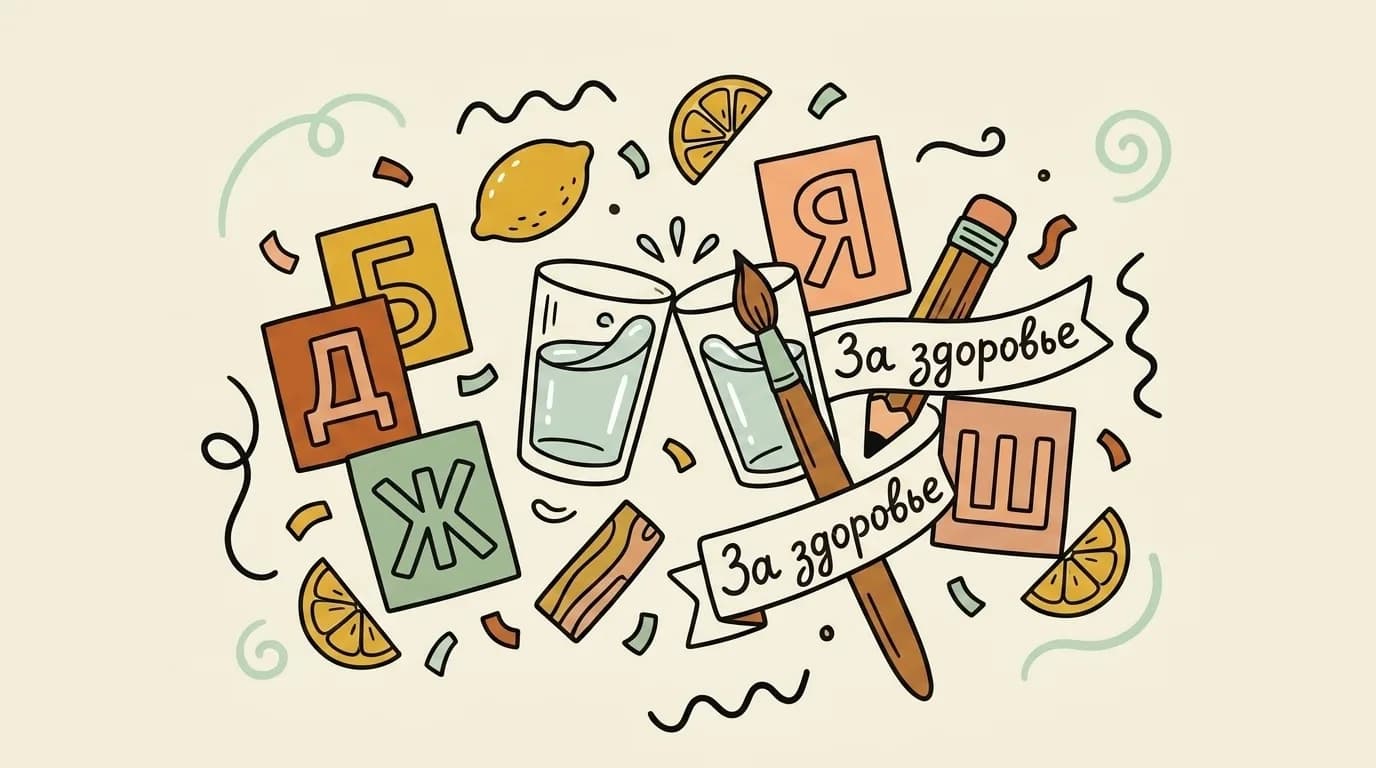
The closest everyday equivalent to "cheers" in Russian is За здоровье (za zdorovye, "to health"). Notice the difference from the myth: it starts with За (za, "to" or "for"), not На (na, "onto"). That tiny preposition changes everything. За is the engine of every Russian toast. You attach it to whatever you want to drink to.
There is also a short, casual option: Будем (budem, "we will be," short for "we will be healthy"). It is the Russian equivalent of clinking glasses and grunting a friendly "cheers" without a speech. Among friends, Будем does the whole job.
So the formula is simple. Take За, add a thing you value, and you have a toast.
Tip: If you remember only one phrase from this post, make it
Заplus a noun.За дружбу(za druzhbu, "to friendship"),За встречу(za vstrechu, "to our meeting"). You can improvise an authentic toast on the spot for the rest of your life.
The Na Zdorovie Myth, Finally Busted
So where did На здоровье come from? It is real Russian, just used for something else entirely. When someone thanks you for a meal, you reply На здоровье (na zdorovye, "you are welcome," literally "to your health, enjoy it"). It is what a grandmother says when you compliment her soup. It means roughly "may it do you good." It belongs at the stove, not over a glass of vodka.
The confusion probably traveled west through Polish and Yiddish, where similar-sounding phrases really are used when drinking. Hollywood did the rest. But if you raise a glass in Moscow and say На здоровье, a Russian will understand you and quietly file you under "learned Russian from movies."
Want to sound like you learned it from a person instead? Use За здоровье when drinking, and save На здоровье for after dinner. While you are collecting these distinctions, my guide to essential Russian phrases covers more of these small choices that separate textbook Russian from the real thing.
Real Russian Toasts You Can Actually Use
Here are the toasts I reach for, with their meaning and when to use them.
| Russian | Transliteration | Meaning | Occasion |
|---|---|---|---|
За здоровье | za zdorovye | To health | The safe, all-purpose opener |
За встречу | za vstrechu | To our meeting | When friends reunite |
За дружбу | za druzhbu | To friendship | Warm gatherings, new bonds |
За любовь | za lyubov | To love | Weddings, romantic dinners |
За вас | za vas | To you (formal or plural) | Honoring your hosts |
За прекрасных дам | za prekrasnykh dam | To the beautiful women | The traditional third toast |
За тех, кого нет с нами | za tekh, kogo net s nami | To those who are not with us | A quiet, serious moment |
A word on the famous "third toast." At a real Russian table there is a rhythm. The first toast is often to the occasion or to health. The second goes to a specific person, the guest of honor or the host. And the third, by deep tradition, is За женщин (za zhenshchin, "to women") or За любовь (za lyubov, "to love"). At military or memorial gatherings the third toast is instead silent, raised to the fallen, drunk without clinking. Knowing which third toast a table is observing tells you a lot about the room. If love is on your mind, my post on how to say I love you in Russian pairs perfectly with За любовь.
Happy Birthday in Russian and Birthday Wishes
Now the phrase you came here for. Happy birthday in Russian is С днём рождения (s dnyom rozhdeniya, "happy birthday," literally "with the day of birth"). It looks intimidating and sounds smoother than it reads. Break it into three beats: s-DNYOM rozh-DYE-niya. Say it slowly a few times and it locks in.
That phrase alone is enough, but Russians love to pile on warm wishes after it. Here are the classics, all built on the verb желаю (zhelayu, "I wish"):
Желаю счастья(zhelayu schastya, "I wish you happiness")Желаю здоровья(zhelayu zdorovya, "I wish you health")Желаю успехов(zhelayu uspekhov, "I wish you success")Всего самого лучшего(vsego samogo luchshego, "all the very best")
String them together and you have a heartfelt birthday toast that any Russian would be touched to hear. For an older relative or your boss, lead with Поздравляю (pozdravlyayu, "congratulations") and keep the wishes formal. For a close friend, С днюхой (s dnyukhoy, "happy bday") is the affectionate slang version. Use it only with people you genuinely know.
Russian Drinking Etiquette: Don't Get This Wrong
The words are only half of it. The ritual matters just as much, and a few rules will keep you on the right side of your hosts.
First, make eye contact when you clink glasses. Russians take this seriously. Looking away as you toast is read as cold, or worse, slightly suspicious. Meet the eyes, clink, then drink.
Second, do not put your glass down between the toast and the sip. Once the toast is given, you drink. Setting the glass back down untouched can look like you are rejecting the sentiment, and at a vodka table it raises eyebrows.
Third, and this one surprises people: never toast with water. There is a strong superstition that toasting with water wishes ill on someone, almost like toasting them to the grave. If you do not drink alcohol, that is completely fine, and nobody worth knowing will pressure you. Just raise juice, wine, or anything other than plain water, and you are safe. An empty raised glass is better than a watery one.
Finally, pace yourself and eat. Russians almost always pair drinks with закуски (zakuski, "appetizers"). The food is not optional decoration. It is the survival strategy that lets a long evening of toasts stay warm and joyful instead of turning into a regret.
If you want to practice these toasts out loud with someone who will gently fix your stress and rhythm before a real dinner, that is exactly what my one-on-one lessons are for. We can rehearse your birthday toast until it sounds effortless.
Try this today
- Say
За здоровье(za zdorovye, "to health") out loud five times, and remind yourself it starts withЗа, notНа. - Practice
С днём рождения(s dnyom rozhdeniya, "happy birthday") in three beats until it feels smooth. - Build one personal toast using
Заplus a noun that matters to you, likeЗа дружбу(za druzhbu, "to friendship"). - Rehearse a two-line birthday wish:
С днём рождения! Желаю счастья(s dnyom rozhdeniya, zhelayu schastya, "happy birthday, I wish you happiness"). - At your next toast with anyone, make real eye contact, keep your glass moving, and never raise water.