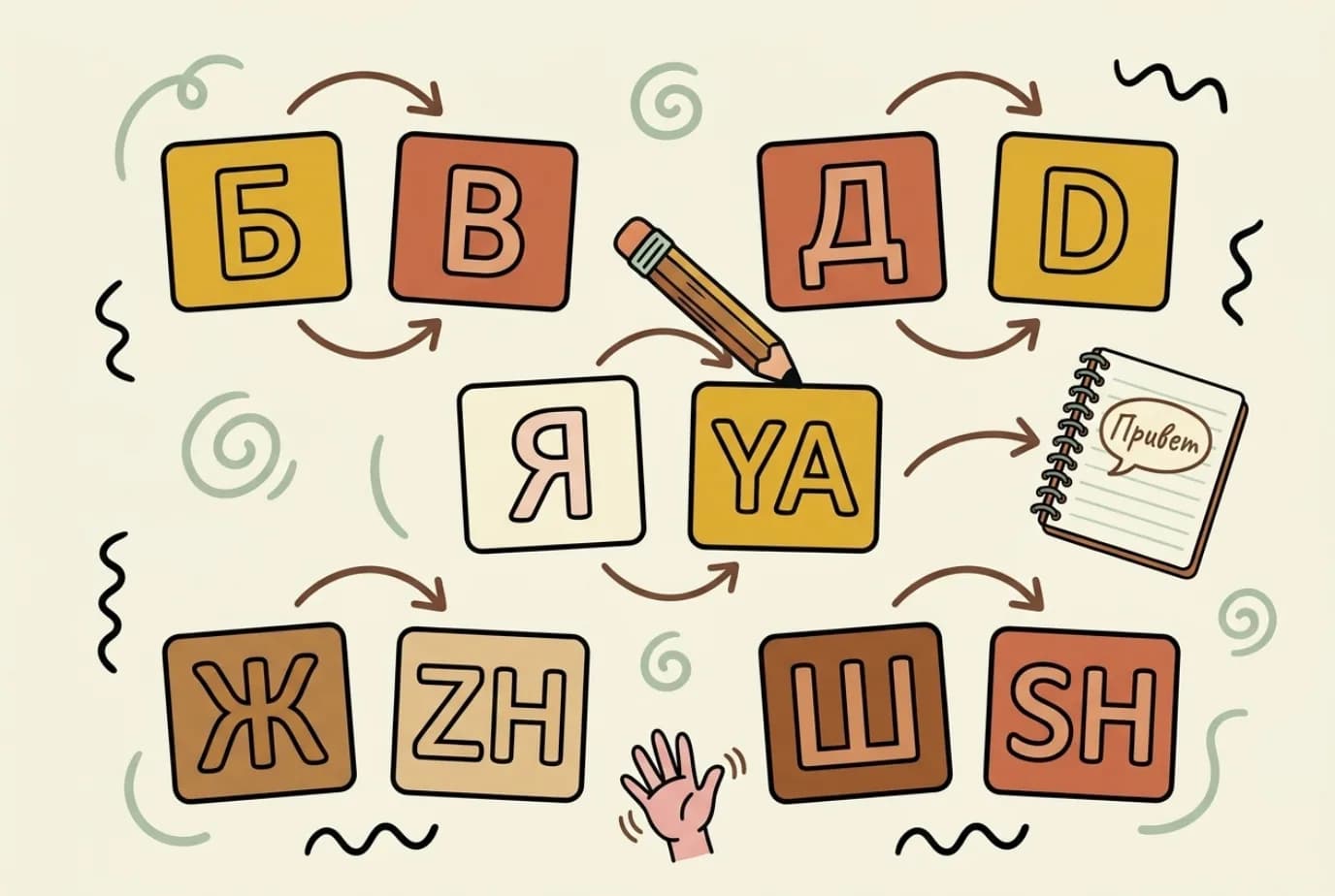
If you need to turn Russian Cyrillic into Latin letters, the first question is what kind of conversion you need. Transliteration represents written letters: Москва becomes Moskva. Pronunciation represents sounds: the same word is roughly “mah-SKVAH” in ordinary speech. Those are related, but they are not interchangeable.
This page is a lookup reference for the modern Russian alphabet. It gives all 33 letters in order, a practical English transliteration, a pronunciation guide, and a Russian example. Transliteration conventions differ, especially for Е, Ё, Й, Ъ, Ь, Ю, and Я, so the table also flags the places where you should expect more than one spelling.
When you are ready to recall the letters without a chart, try the free Russian alphabet quiz. For a memory-based introduction to the shapes, use the separate visual guide to the Cyrillic alphabet.
The complete 33-letter Russian alphabet
The “usual Latin” column uses common learner-friendly spellings. It is not a promise that every passport, map, library catalogue, or academic system will spell a word the same way. For example, the Library of Congress system writes Ё as ë, Й as ĭ, and the two signs as special prime marks. Everyday English often uses yo, y, or no visible mark instead.
| Cyrillic | Usual Latin | Pronunciation guide | Example |
|---|---|---|---|
| А а | a | Stressed: “a” in father | мама — mama, mom |
| Б б | b | “b” in book; may sound like p at the end of a word | банк — bank, bank |
| В в | v | “v” in voice; may sound like f at the end of a word | вода — voda, water |
| Г г | g | “g” in go; may sound like k at the end of a word | год — god, year |
| Д д | d | “d” in dog; may sound like t at the end of a word | дом — dom, house |
| Е е | e; ye initially | After a paired consonant, usually e while making that consonant soft; initially or after a vowel/sign, often ye | нет — net, no; Елена — Elena/Yelena |
| Ё ё | ë; often yo | Stressed yo initially or after a vowel/sign; after a paired consonant, o while usually making it soft | ёлка — ëlka/yolka, fir tree |
| Ж ж | zh | The sound in measure, usually with a hard consonant quality | журнал — zhurnal, magazine |
| З з | z | “z” in zoo; may sound like s at the end of a word | зима — zima, winter |
| И и | i | “ee” in see; usually signals a soft preceding consonant | мир — mir, peace/world |
| Й й | i, ĭ, or y | The consonant y sound, as at the start of yes | мой — moi/moy, my |
| К к | k | “k” in kite | кот — kot, cat |
| Л л | l | A plain “l” or a palatalized “l,” depending on what follows | лампа — lampa, lamp |
| М м | m | “m” in map | метро — metro, metro |
| Н н | n | “n” in net; it only looks like Latin H | нос — nos, nose |
| О о | o | Stressed o; unstressed it is commonly reduced toward a or a weaker vowel | окно — okno, window |
| П п | p | “p” in pen | парк — park, park |
| Р р | r | A tapped or rolled Russian r; it only looks like Latin P | рука — ruka, hand/arm |
| С с | s | “s” in sun; it only looks like Latin C | сок — sok, juice |
| Т т | t | “t” in top | там — tam, there |
| У у | u | “oo” in boot; it only looks like Latin Y | утро — utro, morning |
| Ф ф | f | “f” in fan | фото — foto, photo |
| Х х | kh | A voiceless throat sound, like ch in Scottish loch | хлеб — khleb, bread |
| Ц ц | ts | “ts” at the end of cats | центр — tsentr, centre |
| Ч ч | ch | “ch” in chair, normally soft in Russian | чай — chai, tea |
| Ш ш | sh | A hard, lower-pitched sh | школа — shkola, school |
| Щ щ | shch | In modern standard Russian, a long soft sh sound, approximately /ɕː/; it is distinct from Ш | щука — shchuka, pike |
| Ъ ъ | ʺ; often omitted | No sound of its own. It separates a consonant from following Е, Ё, Ю, or Я, preserving the y glide | подъезд — podʺezd/podyezd, entrance |
| Ы ы | y | A central/back vowel with no direct English equivalent; keep the tongue farther back than for И | мы — my, we |
| Ь ь | ʹ; often apostrophe or omitted | No sound of its own. It can mark a soft consonant or separate it from a following iotated vowel | конь — konʹ/kon', horse |
| Э э | e | “e” in met, without an initial y glide | это — eto, this/it is |
| Ю ю | iu or yu | yu initially or after a vowel/sign; after a paired consonant, u while usually making it soft | юг — iug/yug, south |
| Я я | ia or ya | ya initially or after a vowel/sign; after a paired consonant, a while usually making it soft | яблоко — iabloko/yabloko, apple |
Read, listen, then check yourself
Use the table above for spelling, then listen to the same letters inside real words. The recordings are short enough to repeat. Start at normal speed; use slower playback if you need to separate the sounds.
Вода. Нос. Рука. Сок. Утро.
Water. Nose. Hand. Juice. Morning.
В is v, Н is n, Р is r, С is s and У is u. Read the words, then check the recording.
AI-generated practice audio; not a recording of Alex.
Before playing it again, cover the transcript and read нос, сок, and рука. If you read an English H, C, or P, return to the matching row in the table.
Кот. Москва. Молоко.
Cat. Moscow. Milk.
Stress: кот, Москва́, молоко́. Listen to the unstressed о in Москва and молоко; do not read every о like the vowel in кот.
AI-generated practice audio; not a recording of Alex.
Школа. Щука. Школа. Щука.
School. Pike. School. Pike.
Ш is hard; Щ is a longer, softer sound. The Latin spelling shch is a spelling convention, not an instruction to say sh then ch.
AI-generated practice audio; not a recording of Alex.
Your first three signs in Russian
Try reading these practical words without turning every letter into its English lookalike:
| Sign | Your task |
|---|---|
СТОП | Write the four Latin letters. |
МЕТРО | Find the letter that looks like P but sounds like r. |
РЕСТОРАН | Find both misleading letters: Р and С. |
Check the signs and the misleading letters
СТОП → STOP. МЕТРО → METRO, with Р = r. РЕСТОРАН → RESTORAN, with Р = r and С = s: restaurant. These are transliterations, not complete pronunciation guides.
The next step is the alphabet quiz. For names with several possible English spellings, see Russian names and surnames.
Transliteration records letters; pronunciation changes in context
A transliteration lets someone reconstruct or identify the Russian spelling. It normally keeps a one-to-one relationship as far as the chosen system allows. That is why молоко is transliterated moloko even though its two unstressed О letters do not sound like the stressed final О.
A pronunciation aid answers a different question: what is a speaker likely to say? Russian spelling does not map one letter to one unchanging sound. Three patterns matter immediately:
- Unstressed vowels reduce. In
Москва(Moskva), the firstОis not pronounced like the stressedОinкот(kot). - Consonants can lose voicing. Cornell gives
лук(luk, onion/bow) andлуг(lug, meadow) as words whose final consonants sound alike in standard pronunciation, even though transliteration preserveskversusg. - Following letters affect consonants. Compare
наandня: both end with an “a” vowel, butЯmakes the precedingНpalatalized (soft). Russian palatalization happens as part of the consonant, not as a separate English-style y sound.
This is why a line such as “Е equals ye” is only a rough shortcut. In Елена, an initial ye is a useful English cue. In нет, the letter follows Н: the key effect is a soft Н, followed by an e vowel.
Ъ separates; it does not simply “harden” a consonant
The name hard sign tempts learners into saying that Ъ makes the previous consonant hard. That description misses its central job in modern Russian. Ъ is a separator before Е, Ё, Ю, or Я, especially after a prefix. It tells you that the following letter begins with its y glide instead of merely serving as a soft-vowel indicator.
Compare the structure of подъезд (podʺezd, often written podyezd for learners): the Д and the following ye remain separated. The sign itself is silent. Cornell describes this explicitly as separating a prefix from a root that begins with one of the iotated vowels.
Ь is also silent, but it commonly marks palatalization: кон and конь do not end in the same consonant sound. It can also act as a separator, as in семья (semʹia/sem'ya, family).
Why Щ is written shch but does not sound like two English chunks
Many English-language systems romanize Щ as shch. That spelling is useful because it assigns the letter a distinct Latin form and preserves a historical relationship, but it can mislead you about modern pronunciation. In standard Russian, Щ is generally a single long, soft fricative, approximately /ɕː/. It is not simply Ш plus Ч.
Keep the spelling and sound in separate mental columns:
Ш→ sh → a hard, lower-pitched sh, as inшкола(shkola).Щ→ shch → a long, soft sound, as inщука(shchuka).
The Latin cluster tells you which Cyrillic letter was written. A teacher or recording can help you hear the sound that the cluster cannot capture neatly.
Converting English names into Cyrillic is transcription
Going from an English name to Cyrillic is not the reverse of a fixed alphabet table. Russian normally represents the pronunciation of the name, and established names may have conventional spellings. English also has sounds with no exact Russian equivalent, so results can vary by accent and convention.
| English name | Common Russian spelling | What changed |
|---|---|---|
| John | Джон | English j is represented by Дж |
| Jessica | Джессика | The spelling follows the spoken sounds, not letter-for-letter substitution |
| Michael | Майкл | The English /aɪ/ vowel is represented by ай |
| London | Лондон | This established form maps closely, but it still represents pronunciation |
Use the name in Russian converter for a quick starting point. Treat an automatic result as an approximation unless it matches an established spelling or has been checked by a Russian speaker.
Quick check: transliteration or pronunciation?
Try these before opening the answers.
- Transliterate
чайusing this table. - In
нет, doesЕadd a separate y sound afterН? - What is the main function of
Ъinподъезд? - Why can
лугend with a k sound even though it is transliterated lug? - Is shch an exact English spelling of how
Щsounds?
Answers
- chai (often written chay in informal English-friendly spelling).
- No. It marks the preceding
Нas soft and supplies the e vowel. - It separates the final consonant of the prefix from the following iotated vowel, preserving the ye onset; it has no sound of its own.
- Russian normally devoices a voiced consonant at the end of a word. Transliteration still records the written letter
Гas g. - No. Shch is a romanization convention; modern standard
Щis generally one long soft consonant sound.
Next, move from individual letters to real words with the Russian reading practice guide, then test recall in the Russian alphabet quiz.
If you want direct feedback on palatalization, vowel reduction, Ш versus Щ, or your own name in Russian, book a 1-on-1 Russian lesson.
Sources used for this reference
- Cornell University, Letters and Sounds, Part 2
- Cornell University, Palatalization and paired/unpaired consonants
- Library of Congress, Russian Romanization Table, 2011